2025 Annual Report: Building Preparedness, Strengthening Response
Accessible version of the NDPC 2025 annual report site with clear structure, keyboard navigation, and
text descriptions.
About the 2025 NDPC Annual Report
The FY25 summary charts report 218,926 individuals trained, 2,088,609 contact training hours,
5,849 training deliveries, 95,444 individuals trained online, and 1,562 subject matter experts.
Our mission
The National Domestic Preparedness Consortium remains committed to strengthening the nation's
preparedness by equipping emergency responders with the knowledge and skills needed to prevent,
prepare for, and respond to all hazards, including chemical, biological, radiological, and explosive
threats.
2025 focus areas
Training first responders nationwide.
Supporting large-scale events such as the 2026 FIFA Men's World Cup.
Delivering targeted, region-specific exercises to jurisdictions.
Strengthening response coordination across federal, state, local, tribal, and territorial
partners.
Chairman's letter
2025: Building Preparedness, Strengthening Response
Reflecting on the achievements of 2025, the National Domestic Preparedness Consortium
(NDPC) remains steadfast in its
commitment to strengthening our nation's preparedness. Our mission to equip emergency
responders with the knowledge and
skills needed to effectively prevent, prepare for, and respond to all hazards remains as
vital as ever.
In 2025, the NDPC delivered a portfolio of more than 200 courses, trained 218,926
individuals, and provided our
nation's emergency responders with 2,088,609 contact training hours in every
state and territory. Additionally,
in preparation for the 2026 FIFA Men's World Cup, the NDPC conducted training across
host and supporting jurisdictions
to ensure first responders are ready to protect the millions of spectators, athletes,
and personnel expected to attend.
With over 100,000 responders trained for World Cup, the NDPC's commitment to public
safety remains unwavering for large
scale events such as this, as well as events of all shapes and sizes.
The NDPC's strength lies in our ability to deliver effective, timely, relevant, and
high-quality training to state,
local, tribal, and territorial jurisdictions. As one of the nation's leading providers
of preparedness training,
the NDPC brings training directly to the jurisdictions it serves, addressing
region-specific needs, strengthening
training outcomes, and minimizing the operational burden on local responders and
jurisdictions.
The Consortium's distributed, partner-driven network of instructors and subject matter
experts allows for scalable,
standardized delivery and a coordinated, multidisciplinary approach. This unique
collaboration is the foundation for
resilient, operational preparedness on a national scale.
It is truly an honor to represent a consortium with this noble mission: to train first
responders and to strengthen
preparedness and resilience in the years ahead. The NDPC remains committed to supporting
those who serve on the front
lines and strengthening national preparedness in the years ahead.
1,037,319 Mobile; 458,009 Web-Based;
306,099 Resident; 231,322 Indirect; 54,718 Virtual; 1,143 Just-In-Time. The displayed
components total 2,088,610, one more than the chart's printed total.
This video highlights NDPC member engagement and partnership efforts across the nation. It is
presented in a full-screen background format on the original site, and this accessible version
provides a text summary instead of autoplay media.
A visual background video of networking lines. The accessible page replaces the video with a text
summary to avoid autoplay and ease use for screen readers.
This page includes a map visualization on the original site. In this accessible version, a descriptive
summary and legend are provided for users who cannot access interactive maps.
NDPC training reached every state and territory in 2025. Participant ranges are described below and
include all training delivery types.
0–500 participants
500–2,000
participants
2,000–3,500
participants
3,500–5,000
participants
More than 5,000
participants
Participants trained by state and territory in FY25, with partner breakdowns
State / Territory
CTOS
NCBRT
NDPTC
NMT
SERTC
TEEX
CDP
Total
US Totals
15,645
22,159
6,046
15,346
1,590
74,453
76,274
211,513
Alaska
2
276
30
36
2
367
286
999
Alabama
33
219
166
160
44
793
2,062
3,477
Arkansas
35
43
7
36
6
571
570
1,268
Arizona
880
422
127
202
25
1,249
1,458
4,363
California
1,068
2,072
420
679
6
7,505
3,925
15,675
Colorado
852
390
99
46
193
1,180
796
3,556
Connecticut
27
104
85
50
46
517
929
1,758
Delaware
18
23
43
67
0
149
158
458
Florida
2,363
1,124
531
892
59
3,504
3,631
12,104
Georgia
337
455
163
856
101
1,797
3,032
6,741
Hawaii
163
87
379
147
5
364
747
1,892
Iowa
4
105
112
65
45
319
653
1,303
Idaho
11
97
73
17
2
137
233
570
Illinois
594
620
146
170
28
1,781
3,171
6,510
Indiana
241
226
69
213
84
2,262
696
3,791
Kansas
53
294
67
234
22
800
744
2,214
Kentucky
63
212
218
129
17
898
507
2,044
Louisiana
323
992
44
92
119
694
976
3,240
Massachusetts
212
348
44
127
3
896
1,494
3,124
Maryland
331
796
57
196
65
1,140
1,640
4,225
Maine
20
34
63
60
7
803
312
1,299
Michigan
66
491
224
192
37
481
1,324
2,815
Minnesota
151
201
46
91
11
1,102
781
2,383
Missouri
41
325
125
57
11
953
1,201
2,713
Mississippi
13
111
58
136
23
231
486
1,058
Montana
1
24
29
11
19
189
170
443
North Carolina
203
154
89
301
20
1,186
1,911
3,864
North Dakota
5
10
20
66
6
172
182
461
Nebraska
23
24
5
100
5
248
323
728
New Hampshire
21
63
39
73
14
731
1,091
2,032
New Jersey
620
2,488
322
1,829
74
2,881
2,254
10,468
New Mexico
21
660
49
51
1
597
557
1,936
Nevada
345
145
8
88
10
1,825
1,000
3,421
New York
1,483
6,401
405
2,553
46
9,682
10,289
30,859
Ohio
210
546
106
434
19
1,353
1,103
3,771
Oklahoma
7
3,099
20
170
22
835
1,047
5,200
Oregon
48
174
140
40
3
615
373
1,393
Pennsylvania
470
657
105
133
61
1,629
3,639
6,694
Rhode Island
100
32
37
138
11
402
776
1,496
South Carolina
152
1,044
18
42
41
1,042
1,515
3,854
South Dakota
34
25
64
947
9
341
138
1,558
Tennessee
267
186
103
1,535
30
1,636
845
4,602
Texas
2,735
912
185
251
100
9,612
3,717
17,512
Utah
19
204
3
348
33
179
554
1,340
Virginia
368
581
60
22
32
4,734
3,091
8,888
Vermont
0
41
3
188
0
110
252
594
Washington
305
558
148
209
16
1,231
1,381
3,848
Wisconsin
67
351
157
20
30
635
1,498
2,758
West Virginia
69
82
1
24
12
334
507
1,029
Wyoming
2
60
28
1
13
278
140
522
Washington DC
122
291
42
23
1
130
1,067
1,676
American Samoa
0
39
61
147
0
62
1
310
Guam
0
6
21
115
0
31
62
235
Northern Mariana Islands
0
66
72
86
0
119
9
352
Puerto Rico
45
466
148
0
1
385
349
1,394
Virgin Islands
0
69
162
9
0
74
139
453
Armed Forces Americas
0
5
0
0
0
0
2,490
2,495
Armed Forces Europe/Canada/Middle East/Africa
0
65
0
0
0
11
376
452
Armed Forces Pacific
115
0
0
5
0
5
76
201
Federated States of Micronesia
0
0
0
0
0
0
1
1
Marshall Islands
2
0
0
0
0
0
0
2
Palau
0
2
0
16
0
18
2
38
Other
0
39
0
412
0
1
0
452
International
0
1
0
9
0
647
1,537
2,194
The original site provides an interactive U.S. map and a state selector. If you need keyboard or
assistive technology access, use the text summary above and follow the contact resources listed below
for additional support.
Testimonials
NDPC partners and participants describe the positive impact of training and coordination efforts across
the nation.
Thomas Hauck
Director, New Jersey Office of Homeland Security and Preparedness
"As New Jersey prepares to host the FIFA World Cup 2026™, the National Domestic Preparedness
Consortium has been an invaluable partner in ensuring our first responders and critical
infrastructure partners have access to vital training that will aid in keeping our communities and
visitors safe."
Tim Tipton
Commissioner, State of Oklahoma Department of Public Safety
"The NDPC maintains strong relationships not only with federal agencies but with leadership from
State, Local, Tribal and Territorial agencies, enabling agile coordination during times of national
need."
Maria Toma
Fire Administrative Assistant; Puerto Rico Department of Search and Rescue
Training partner: National Disaster Preparedness Training Center (NDPTC)
"This training is very important to all of us, especially our first responders as it mostly pertains
to natural disasters. This is a way for us to communicate and come together as one so that we can
have a prepared plan for when disaster comes to our community."
RDPC Participant
Participant from the Rural Domestic Preparedness Consortium
Training partner: Rural Domestic Preparedness Consortium (RDPC)
"Great course for the collaboration between law enforcement departments, 911, fire and school
administration."
Jacob Kurt
EMT/FF, Independence Fire Rescue; Independence, IA
Training partner: Security and Emergency Response Training Center (SERTC)
"As an avid learner, I've had the opportunity over the past few years to attend certification
courses across a wide array of disciplines throughout the country. It's rare to find a program
where the instructors are not only subject matter experts but also gifted educators. Too
often, the two don't go hand-in-hand—someone may be an expert but struggle to teach or be a
great teacher without the depth of experience. Your team is an elite combination of both. I was
continually impressed by the clarity, professionalism, and passion each instructor brought to
the classroom and the field."
Michael E. Russas, MEP
Security and Emergency Preparedness Program Manager; Corporate Security & Emergency Preparedness;
Massachusetts Port Authority
Training partner: Texas A&M Engineering Extension Service (TEEX)
"The World Cup Boston '26 Capability Readiness and Development Working Group identified the 440
course as a critical training opportunity for the region. I had the opportunity to take this
course, and know first-hand how invaluable it was. Many of the participants noted that this
wasn't just a regular federal emergency management course, stuffed with irrelevant information --
but rather, really great content, guidance, and a mix of exercises and activities that went a
long way in enhancing partnerships and relationships. I believe this was an outstanding
opportunity for our stakeholders ahead of FIFA 2026, and will go a long way in enhancing
preparedness in the region for special events for the years to come."
Bethpage, New York
Course participant location
Training partner: Counter Terrorism Operations Support (CTOS)
"Great course, knowledgeable instructors, just the right amount of lecture and hands-on training."
John Behr
Patrol Commander; Hasbrouck Heights Police Department
Training partner: Energetic Materials Research and Testing Center (EMRTC)
"As we enter a critical period of preparation in the tri state area for the upcoming FIFA World Cup
matches,
I wanted to take a moment to personally thank you and recognize the impact your program has had on
our
law enforcement personnel who will be working throughout the event, as well as during the weeks
leading up
to and following it. Officers from several of the agencies in our group regularly attend your
training,
including East Rutheford, Carlstadt, Hasbrouck Heights, Little Ferry, and South Hackensack. These
departments
represent the immediate surrounding jurisdictions within approximately one to three miles of the
stadium and
their role during the World Cup will be significant. As we continually seek out the best training
opportunities
for our officers, I wanted to share the feedback regarding the instruction you provide through the
New Mexico Tech
program, that it has been outstanding. That praise comes directly from our frontline officers who
benefit from
the knowledge and practical experience your program delivers. Your commitment to providing
high-quality training
plays an important role in helping our officers prepare for complex events such as this, and is
greatly appreciated."
HMT student
Course participant
Training partner: Center for Domestic Preparedness (CDP)
"As a trainer, I care about quality instructors and hold them to a high standard. I was thoroughly
impressed about
the qualities of all the instructors we had this week. They were excellent communicators and very
knowledgeable.
They were professional and personable at the same time. Very impressed with their skills and
quality."
Partner Organizations and Images
The NDPC is supported by partner organizations that deliver specialized emergency preparedness training.
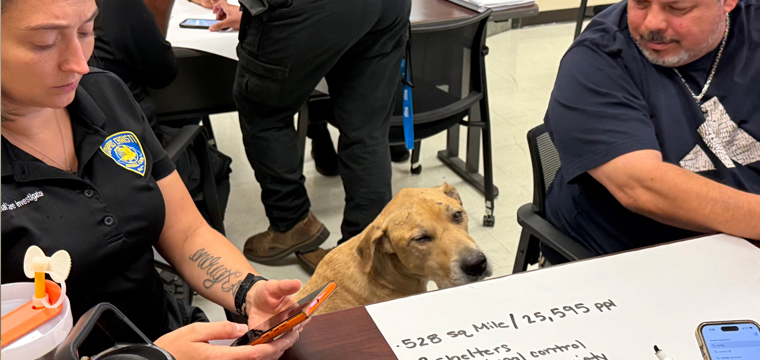
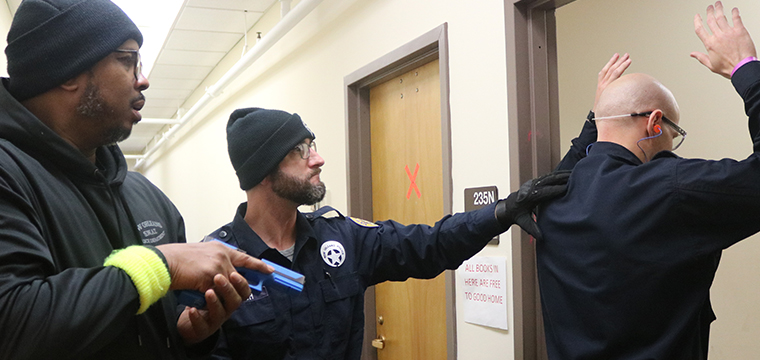
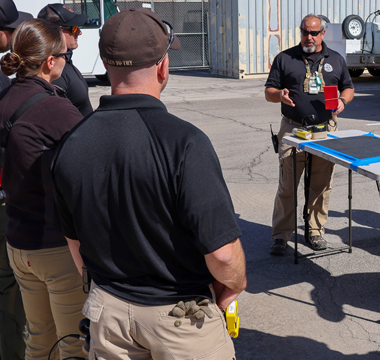
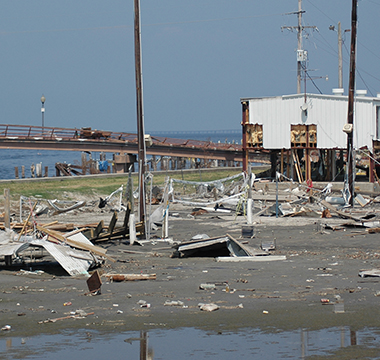
Center for Domestic PreparednessCenter for Domestic PreparednessCenter for Domestic PreparednessRural Domestic Preparedness ConsortiumLSU NCBRT/ACE trainingCTOS training eventNational Disaster Preparedness Training CenterEnergetic Materials Research and Testing Center, New Mexico TechSecurity and Emergency Response Training CenterNational Emergency Response and Recovery Training Center / Texas A&M Engineering
Extension Service
Partner Impact Maps and Data
The original report presents the following partner graphics as maps and infographics. Text below each
image provides the important labels, figures, geographic patterns, and qualifications in readable
form.
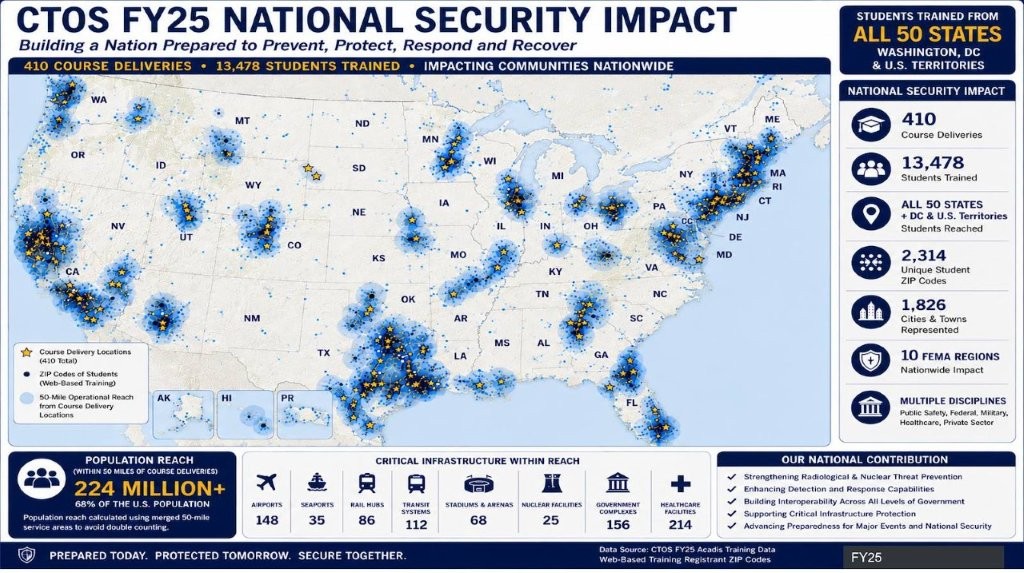
CTOS FY25 National Security Impact
CTOS FY25 National Security Impact. Report period: FY25.
The graphic reports 410 course deliveries and 13,478 students trained, reaching all 50 states,
Washington, D.C., and U.S. territories. It also reports 2,314 unique student ZIP codes and 1,826
cities and towns represented across 10 FEMA regions. The map uses stars for course delivery
locations and shaded circles for 50-mile operational reach; locations are distributed nationwide,
with visible clusters in California, Texas, the Gulf Coast, the Great Lakes, and the Northeast.
CTOS estimates a population reach of more than 224 million people, or 68% of the U.S. population,
calculated from merged 50-mile service areas. This is an estimated service-area reach, not a count
of people trained. The graphic counts nearby critical infrastructure within reach: 148 airports,
35 seaports, 86 rail hubs, 112 transit systems, 68 stadiums and arenas, 25 nuclear facilities,
156 government complexes, and 214 healthcare facilities.
The stated national contributions are strengthening radiological and nuclear threat prevention;
enhancing detection and response capabilities; building interoperability across government;
supporting critical infrastructure protection; and advancing preparedness for major events and
national security.
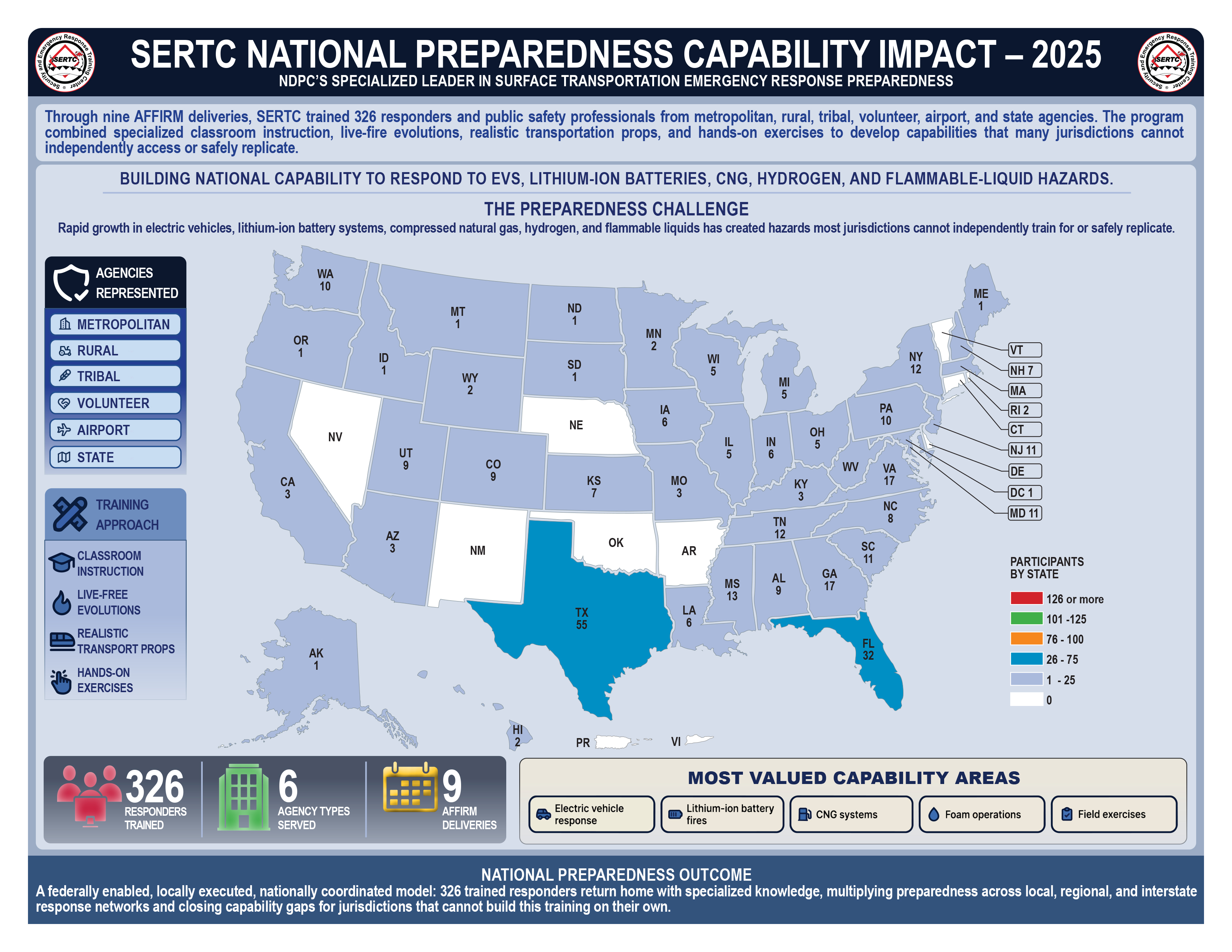
SERTC National Preparedness Capability Impact
SERTC AFFIRM program map and capability summary, 2025.
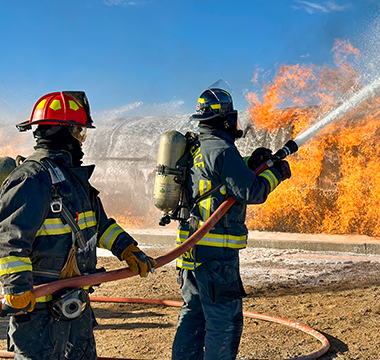
The graphic describes nine Alternative Fuels and Flammable Incident Response and Management
(AFFIRM) deliveries, six agency types served, and 326 responders trained. Its state map shows the
largest labeled counts in Texas (55), Florida (32), Georgia (17), Virginia (17), Mississippi
(13), Tennessee (12), New York (12), Maryland (11), New Jersey (11), Washington (10), and
Pennsylvania (10). Participants represented metropolitan, rural, tribal, volunteer, airport, and
state agencies.
AFFIRM training combines classroom instruction, live-fire evolutions, realistic transportation
props, and hands-on exercises. The capability focus is electric-vehicle response, lithium-ion
battery fires, compressed natural gas (CNG) systems, foam operations, and field exercises. The
graphic says these specialized facilities and training help jurisdictions address hazards they
may not be able to train for or safely replicate independently.
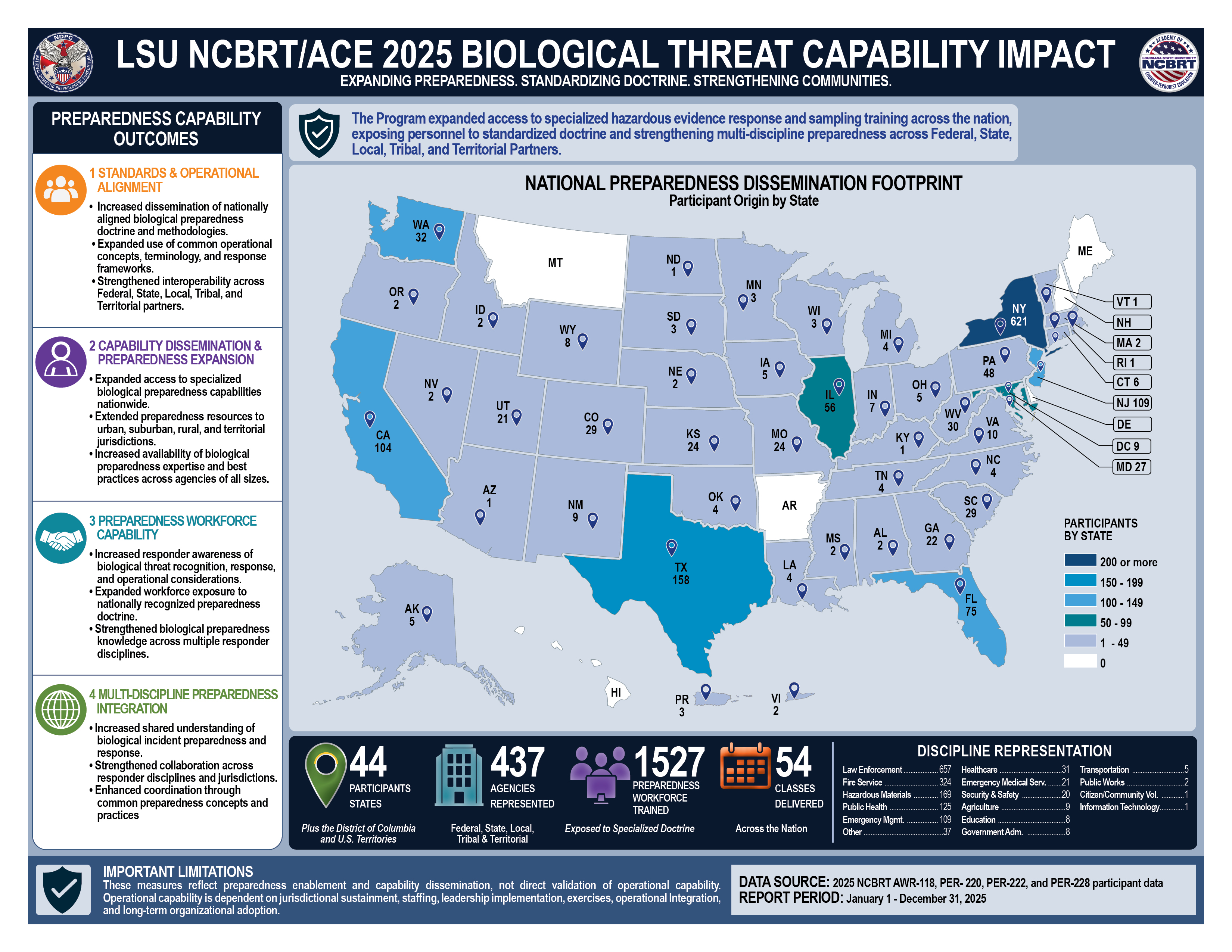
LSU NCBRT/ACE Biological Threat Capability Impact
LSU NCBRT/ACE 2025 Biological Threat Capability Impact. Report period: January 1 to December 31, 2025.
The graphic reports 1,527 preparedness-workforce participants trained, 437 agencies represented,
54 classes delivered, and participants from 44 states plus the District of Columbia and U.S.
territories. The largest state counts shown are New York (621), Texas (158), California (104),
Florida (75), Illinois (56), and Washington (32). The graphic also reports participant counts
for other states and selected territories; unmarked map areas should not be interpreted as zero
unless explicitly labeled.
Its four preparedness capability outcome areas are: standards and operational alignment;
capability dissemination and preparedness expansion; preparedness workforce capability; and
multi-discipline preparedness integration. The graphic describes expanded access to specialized
hazardous-evidence response and sampling training, standard doctrine, improved interoperability,
and broader biological-threat recognition and response readiness.
The discipline breakdown is: law enforcement 657; fire service 324; hazardous materials 169;
public health 125; emergency management 109; other 37; healthcare 31; emergency medical services
21; security and safety 20; agriculture 9; education 8; government administration 8;
transportation 5; public works 2; citizen/community volunteer 1; and information technology 1.
The source lists 2025 AWR-118, PER-220, PER-222, and PER-228 participant data. It cautions that
these measures show preparedness enablement and capability dissemination, not direct validation
of operational capability.
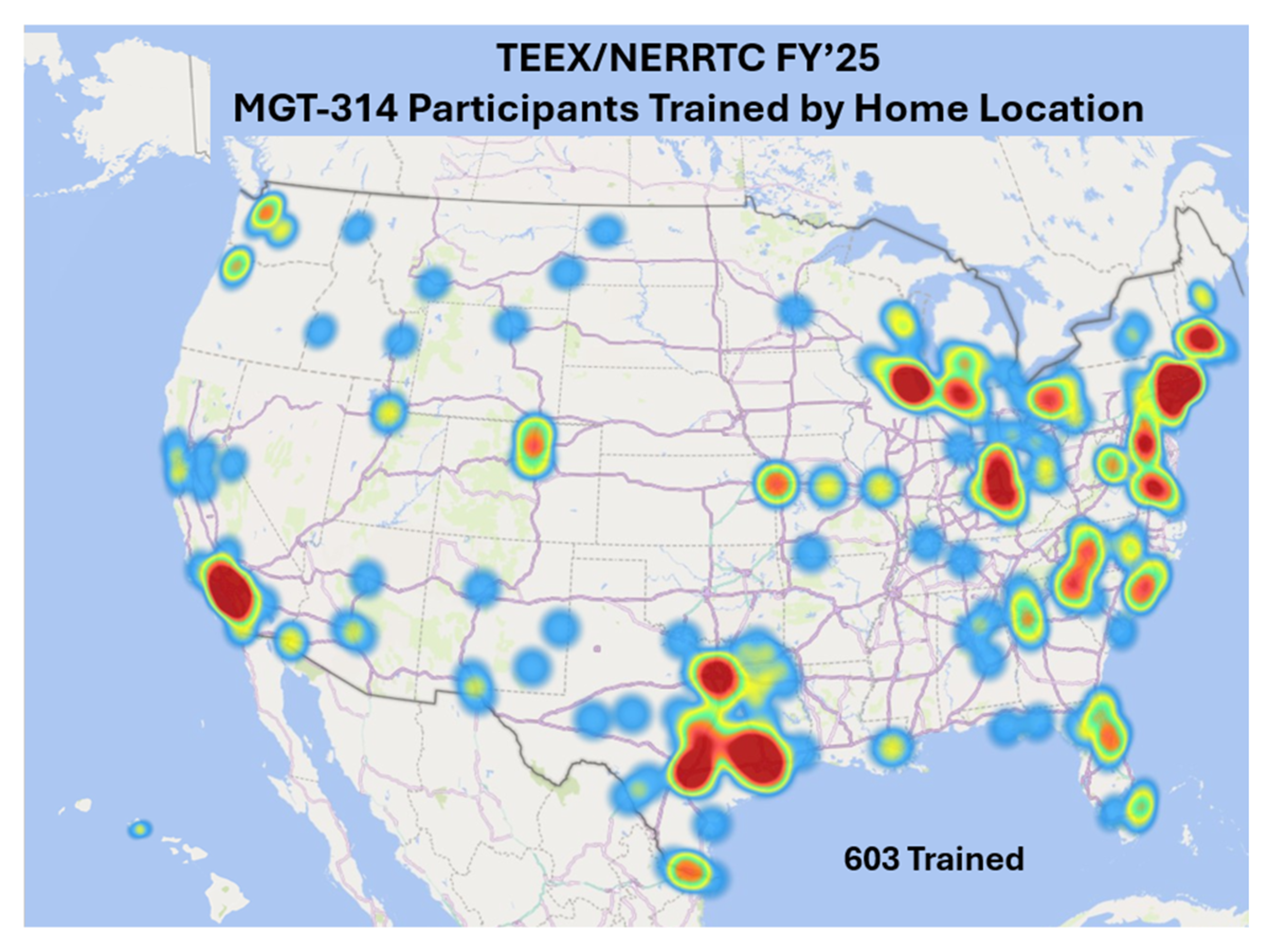
TEEX/NERRTC MGT-314 National Operational Impact
TEEX/NERRTC FY25 MGT-314 participants by home location.
The map reports 603 participants trained. It shows participant locations across the United States,
with visible clusters in California, Texas, the Gulf Coast, the Midwest, the Northeast, and
Florida. The heat-map colors indicate relative concentration; the graphic does not provide
exact state-by-state counts.
MGT-314 is Enhanced Incident Management/Unified Command for All Hazards, a simulation-based
capstone course. It prepares state, local, tribal, and territorial personnel to coordinate
command, communications, resource management, and decisions during complex incidents. The
original page also describes application of this training during a Los Angeles wildfire response,
including evacuation decisions, interagency coordination, and resource prioritization.
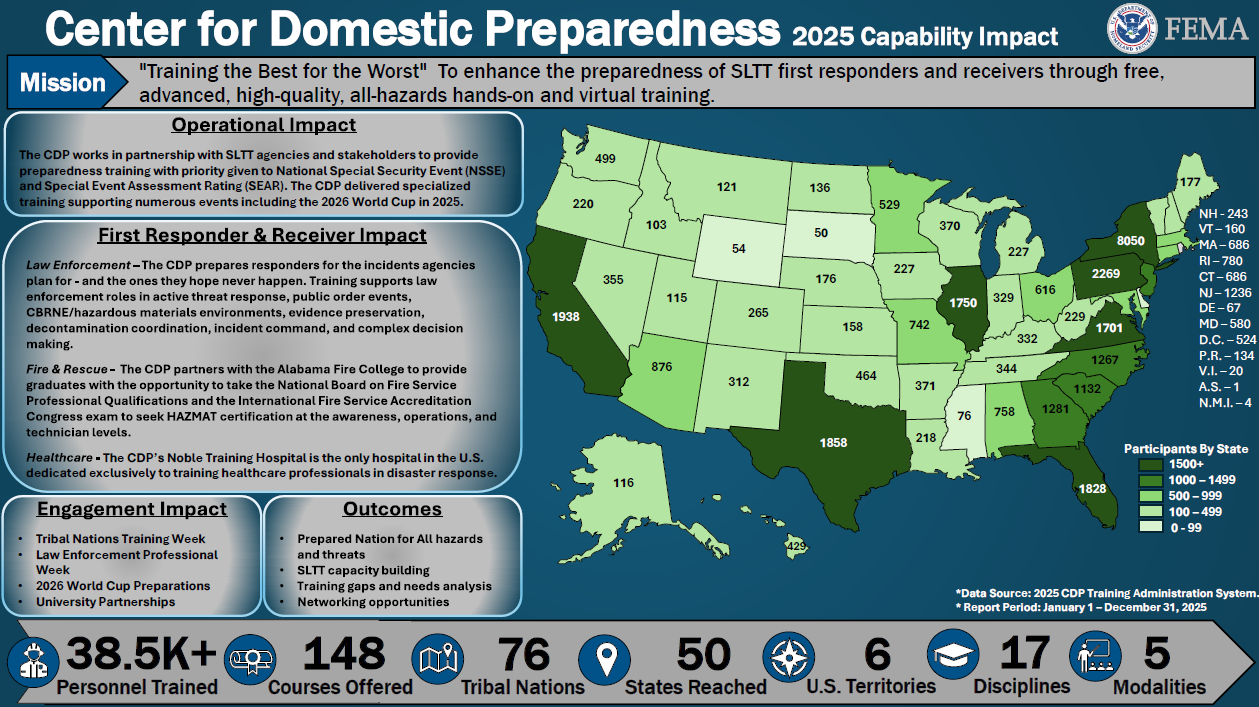
Center for Domestic Preparedness 2025 Capability Impact
Center for Domestic Preparedness 2025 Capability Impact. Report period: January 1 to December 31, 2025.
The graphic reports more than 38,500 personnel trained, 148 courses offered, 76 Tribal Nations,
50 states reached, six U.S. territories, 17 disciplines, and five training modalities. Its map
provides state-level participant counts, with additional values listed for New Hampshire,
Vermont, Massachusetts, Rhode Island, Connecticut, New Jersey, Delaware, Maryland, Washington,
D.C., Puerto Rico, the U.S. Virgin Islands, American Samoa, and the Northern Mariana Islands.
The operational-impact text says CDP works with state, local, tribal, and territorial agencies and
stakeholders, including training for National Special Security Events and Special Event
Assessment Rating events. It highlights law-enforcement response, public-order events,
CBRNE/hazardous-materials environments, evidence preservation, decontamination coordination,
incident command, fire and rescue certification, and healthcare disaster response. Listed
engagement areas include Tribal Nations Training Week, Law Enforcement Professional Week, 2026
World Cup preparations, and university partnerships. The stated outcomes include all-hazards
preparedness, capacity building, training-gap analysis, and networking.
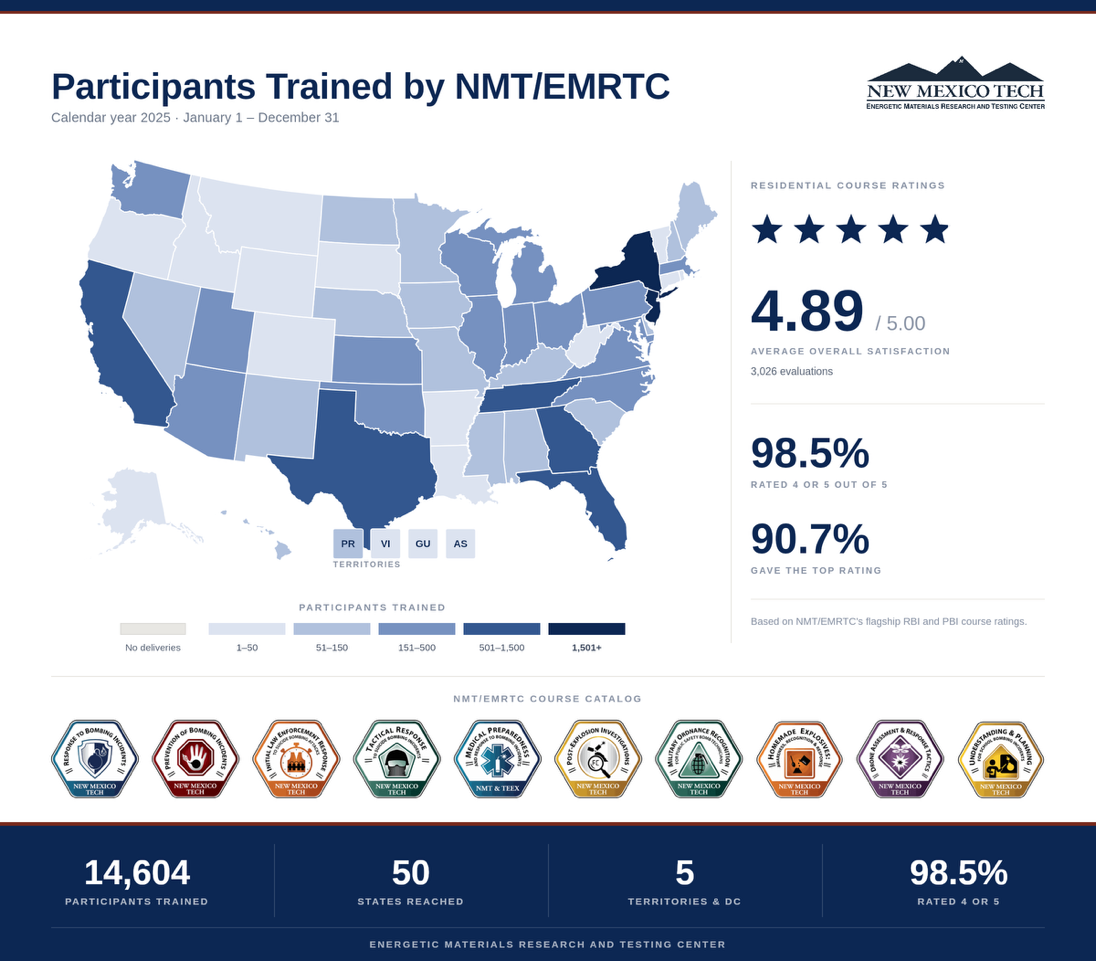
NMT/EMRTC Participants Trained
Energetic Materials Research and Testing Center (EMRTC), calendar year 2025.
The graphic reports 14,604 participants trained, reaching all 50 states and five territories plus
the District of Columbia. It shows a state choropleth with categories of no deliveries, 1 to 50,
51 to 150, 151 to 500, 501 to 1,500, and more than 1,500 participants; individual state counts
are not printed on the map.
Residential course ratings averaged 4.89 out of 5 across 3,026 evaluations. The graphic reports
98.5% rated the course 4 or 5 out of 5, and 90.7% gave the top rating. Ratings are identified as
based on EMRTC's flagship RBI and PBI course ratings.
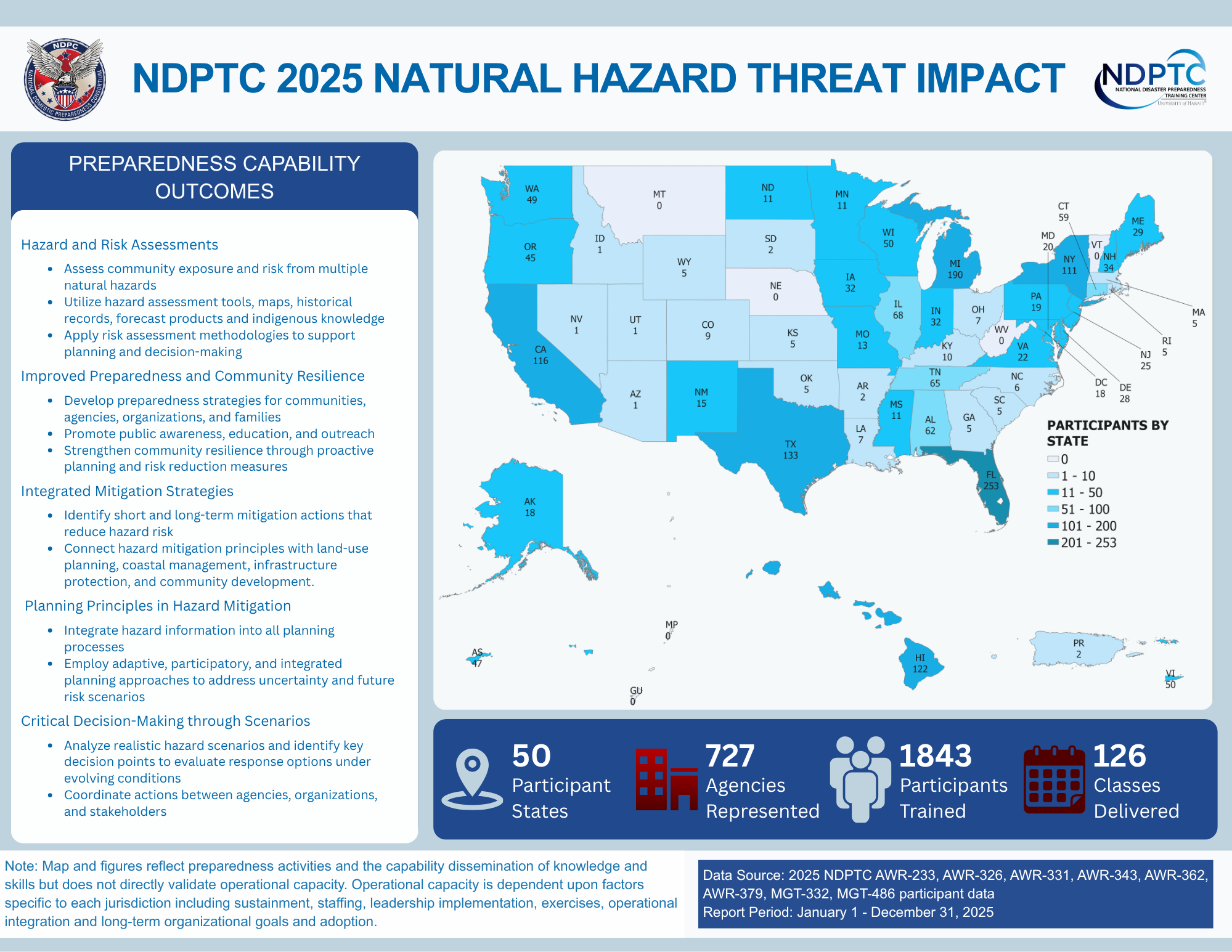
NDPTC 2025 Natural Hazard Threat Impact
National Disaster Preparedness Training Center natural hazard threat impact. Report period: January 1 to December 31, 2025.
The graphic reports 1,843 participants trained, 727 agencies represented, 126 classes delivered,
and participants from 50 states. The map prints counts by state and territory. Its highest shown
state counts are Florida (253), Michigan (190), Texas (133), Hawaii (122), California (116),
New York (111), Wisconsin (50), and Washington (49). The map legend ranges from zero through
201 to 253 participants.
Capability outcomes cover hazard and risk assessments; improved preparedness and community
resilience; integrated mitigation strategies; planning principles in hazard mitigation; and
critical decision-making through scenarios. The graphic says these measures reflect the
dissemination of knowledge and skills, not direct validation of operational capacity. Its data
source lists 2025 participant data for AWR-233, AWR-326, AWR-331, AWR-343, AWR-362, AWR-379,
MGT-332, and MGT-486.
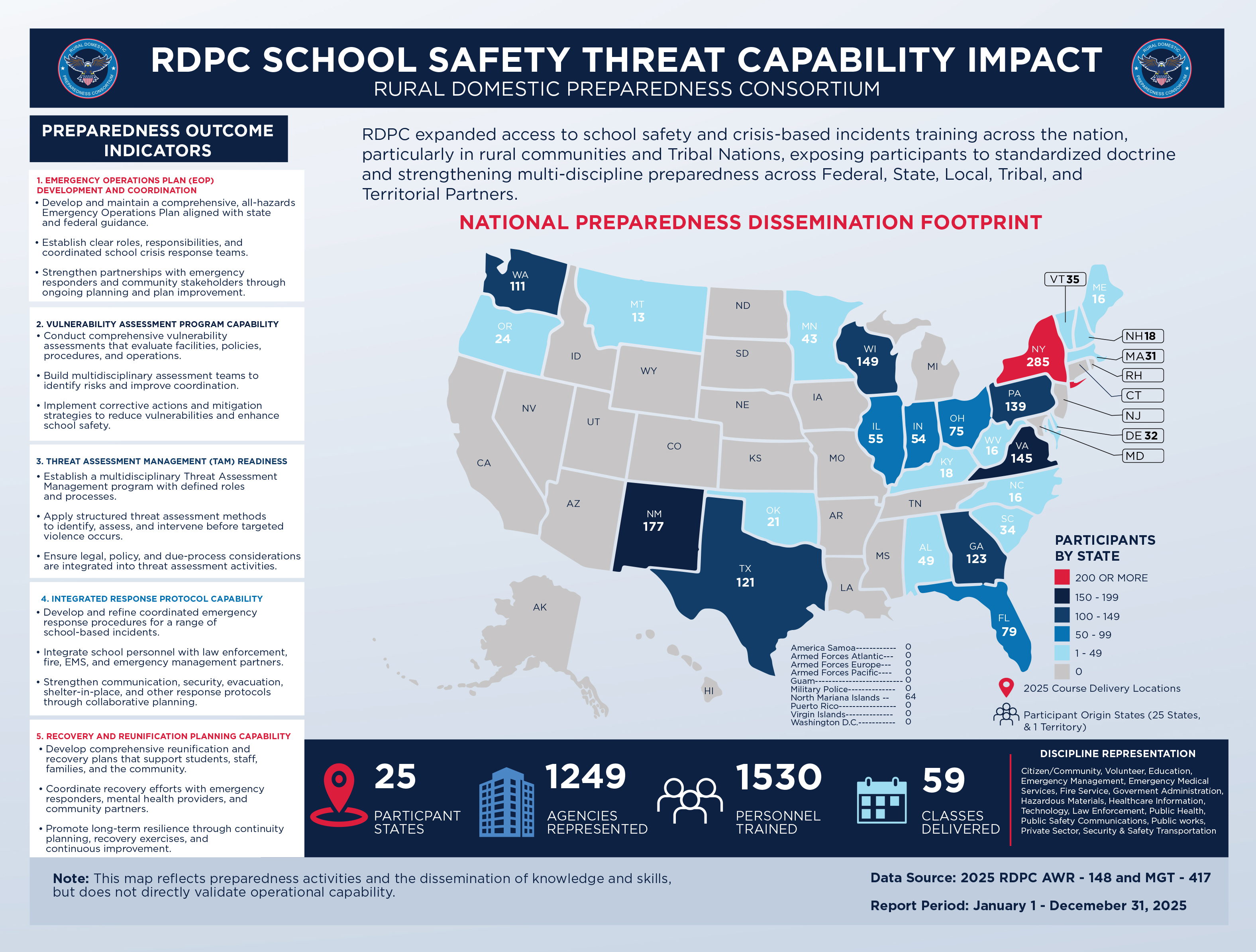
RDPC School Safety Threat Capability Impact
Rural Domestic Preparedness Consortium school safety threat capability impact. Report period: January 1 to December 31, 2025.
The graphic reports 1,530 personnel trained, 1,249 agencies represented, 59 classes delivered,
and participants from 25 states and one territory. State counts printed on the map include New
York (285), Wisconsin (149), Virginia (145), Pennsylvania (139), Texas (121), Washington (111),
Georgia (123), New Mexico (177), and Florida (79). Its legend distinguishes 200 or more,
150 to 199, 100 to 149, 50 to 99, 1 to 49, and zero participants. The graphic states that
RDPC is an institutional partner.
Preparedness outcome areas include emergency operations plan development and coordination;
vulnerability assessment; threat assessment management readiness; integrated response protocols;
and recovery and reunification planning. The map note says it reflects preparedness activities
and dissemination of knowledge and skills, but does not directly validate operational capability.
The listed data sources are 2025 RDPC AWR-148 and MGT-417.
Contact Information
For additional questions or support, contact the partner
organizations directly.